
Revenue Stacking: How a BESS Can Earn on Energy Arbitrage, Ancillary Services (FCR, aFRR, mFRR), and Peak Shaving Simultaneously
Introduction
Building the economics of a utility-scale Battery Energy Storage System (BESS) relying solely on a single revenue stream is a direct path to losses. Spot markets are volatile, electricity prices fluctuate wildly, and pure energy arbitrage no longer guarantees a return on capital within a reasonable timeframe.
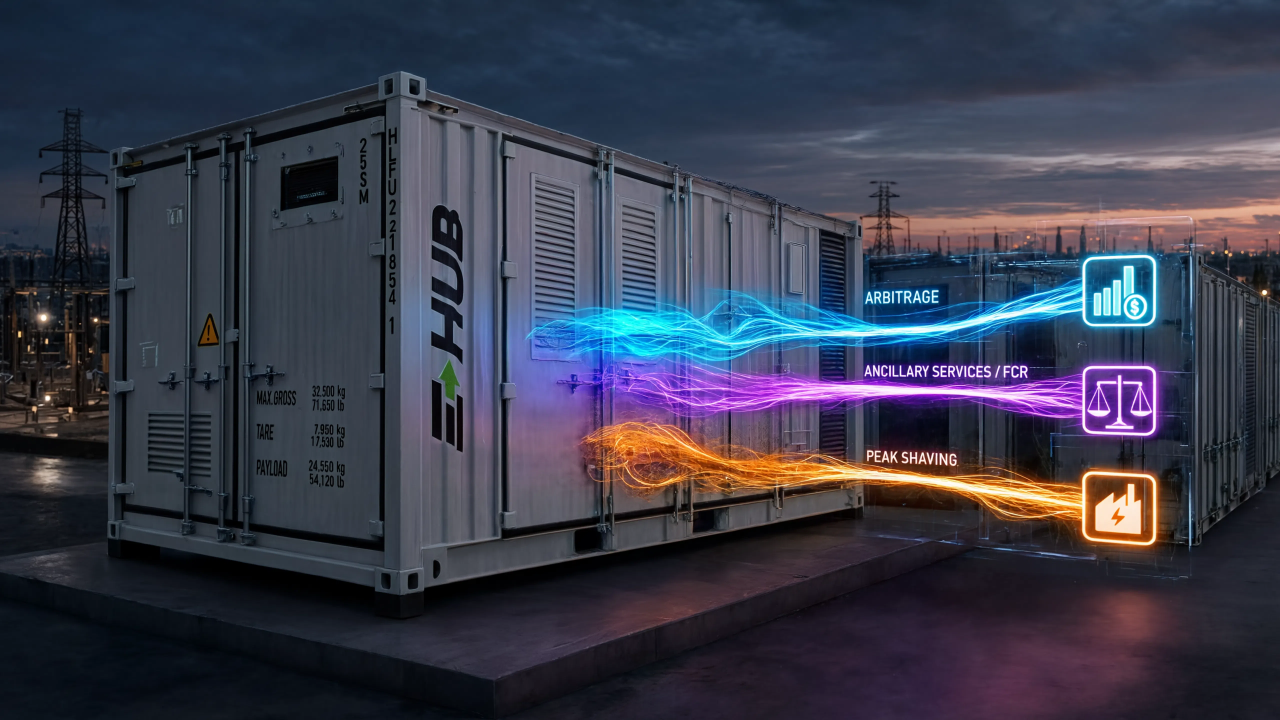
That is why the modern storage market has shifted toward Revenue Stacking. The concept is simple: the exact same physical BESS container can simultaneously (or sequentially throughout the day) monetize its capacity and power across multiple markets.
Let’s break down how revenue stacking works in the cutting-edge markets of the US (PISO, CAISO, ERCOT) and Europe (Germany, UK), and why it is changing the rules of the game for investors and engineers.
1. Stack Architecture: What Comprises BESS Revenue?
To understand the mechanics of revenue stacking, we can divide the available monetization instruments into three key tiers:
- Energy Arbitrage (Day-Ahead / Intraday): Buying cheap electricity (for instance, during midday solar generation troughs) and selling it during peak evening demand hours.
- Ancillary Services (FCR, aFRR, mFRR): Participating in real-time grid frequency regulation. This is the highest-margin yet technically demanding segment.
- Peak Shaving / Demand Charge Management: Locally reducing peak loads (often relevant for C&I facilities or distributed generation) to lower infrastructure grid costs.
2. Market Mechanics: US vs. Europe
While the concept of revenue stacking is universal, the rules of the game in US and European markets differ radically due to regulatory frameworks and power grid structures.
A. North American Markets (ERCOT, PJM, CAISO)
- Characteristics: US markets are highly liquid and managed by Independent System Operators (ISOs/RTOs). Co-optimized markets are the standard here.
- How the Stack Works: In Texas (ERCOT) or California (CAISO), Energy Management System (EMS) software can submit bids hourly to both the energy market (Day-Ahead) and regulation reserves (Ancillary Services). If spot prices spike, the algorithm automatically redirects battery power to energy sales, temporarily reducing reserve participation.
- Main Driver: High price volatility (spikes exceeding $2000+ per MWh during peak loads or storms) makes US arbitrage super-profitable on top of baseline Resource Adequacy capacity payments.
B. European Markets (Continental Europe: Germany, UK, Scandinavia)
- Characteristics: Europe is heavily regulated by Transmission System Operators (TSOs) and split into distinct bidding zones. Historically, the European BESS market was built around frequency reserves: FCR (Frequency Containment Reserve) and aFRR (automatic Frequency Restoration Reserve).
- How the Stack Works: For a long time, batteries in Germany earned solely on FCR. As that market saturated, margins compressed. Now, operators deploy complex stacks: reserving 50% capacity for fast frequency response (FCR/aFRR) while routing the remaining power capacity into intraday spot markets and arbitrage.
- Main Driver: The explosive growth of renewables (solar and wind) creates massive frequency swings and negative spot prices, unlocking huge arbitrage opportunities paired with balancing markets.
3. Anatomy of Conflicts: Why Stacking is a Job for Advanced EMS, Not Excel
On paper, revenue stacking looks simple: combine all three streams and multiply revenues by three. In reality, battery physics imposes strict constraints.
- Conservation of Energy: A battery has fixed MW (power) and MWh (capacity). If you promise power for frequency containment (FCR), you cannot simultaneously discharge that exact same battery to the grid at speculative prices on the Day-Ahead spot market.
- Cell Degradation: Constant switching between high-cyclicity regimes (arbitrage) and continuous micro-cycling (FCR) accelerates electrochemical wear.
The Solution: The success of a revenue-stacking project depends 90% not on the brand of the cells, but on the EMS (Energy Management System). Smart predictive software calculates market margins in real time, forecasts prices, accounts for degradation, and redistributes battery capacity across tasks every single minute.
Conclusion
Revenue Stacking transforms a BESS from a passive box of lithium into a high-yielding financial and technical instrument. In the US and European markets, the winners aren’t those with the biggest battery — they are the ones with the smartest orchestration.
Investing in hardware without an advanced EMS is like buying a Ferrari with no steering wheel. Stop obsessing over lithium cells; the real intelligence and profit live in the software.
Let’s settle this in the comments: Are you still betting your portfolio on raw hardware capacity, or do you believe that multi-market software optimization is the only thing keeping modern storage economics alive?
Drop your arguments below! ⚡️
Drop your arguments below! ⚡️
Originally published by E-HUB energy on LinkedIn. View the original article.