
The Cost of Short-Term Profit: How BESS Cycling Destroys Battery Value
Author: E-HUB Energy Team Specialization: European manufacturer of industrial energy storage systems (BESS, «Made in Poland»)
In the European electricity markets (Day-Ahead Market, Intraday), the rules of the game appear exceptionally attractive to energy storage owners. Price volatility is surging: during solar or windy hours, the cost of a megawatt-hour can drop to zero or turn negative, while during peak hours, it can skyrocket to hundreds of euros.
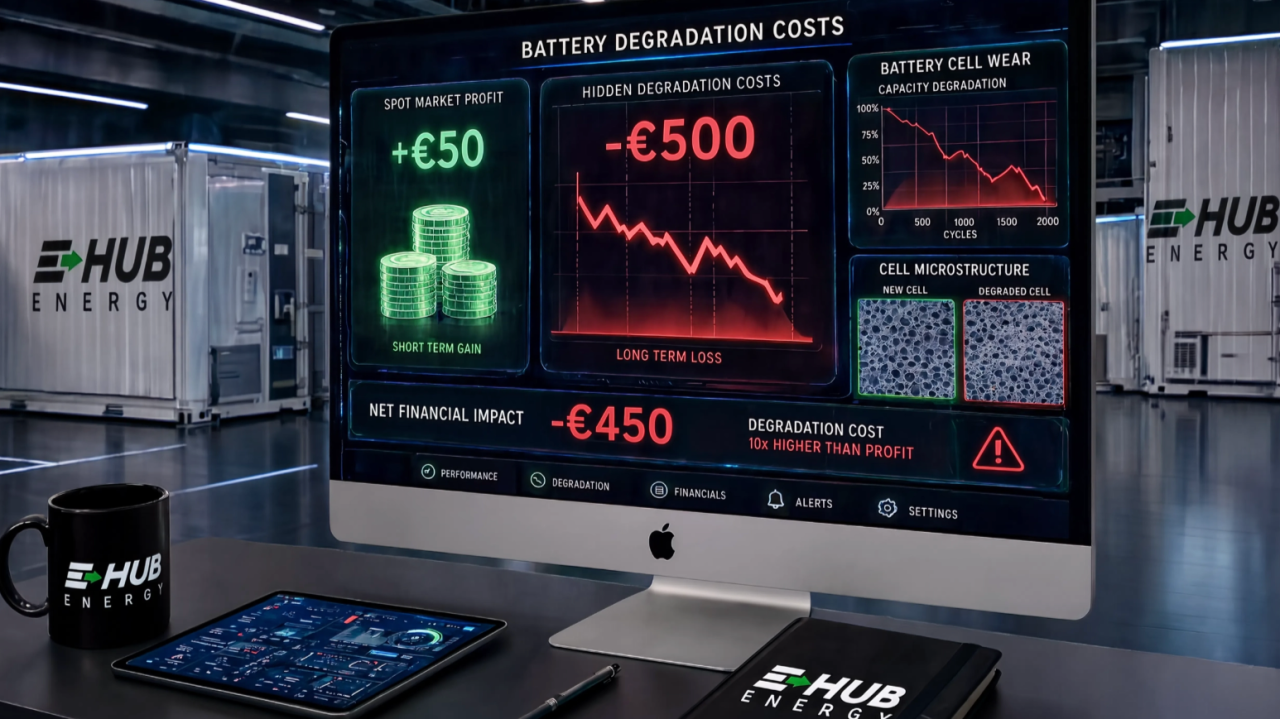
The temptation is obvious: configure the Energy Management System (EMS) to catch every single price spike. Charge cheap, discharge expensive—and make a conditional €50 on the spot price spread. However, behind this glossy picture of momentary margin often lies a trap that investors and inexperienced operators notice far too late.
The name of this trap is Degradation Cost. Trying to «squeeze» an extra €50 out of the market, the algorithm can quietly strip away battery capacity worth €500.
1. The Illusion of Easy Money: How Spot Arbitrage Works
A typical scenario actively promoted by certain software integrators or aggregators sounds alluring:
- «Let’s cycle the battery 3–4 times a day!»
- «Look at the price curve: a drop at 14:00, a peak at 19:00. We charge, we discharge, and repeat at night.»
On paper, this looks like a flawless continuous cash flow generator. The system runs, the terminal displays green transaction numbers, and the asset owner is satisfied.
However, an industrial battery is not an infinite reservoir. It is a high-tech electrochemical complex (E-HUB systems utilize premium prismatic LFP cells such as EVE MB31 314Ah) with a strict resource limit — the number of equivalent full cycles (Cycle Life) before capacity drops to 70–80% (SOH — State of Health). Every micro-cycle and every attempt to react to minute-to-minute price fluctuations triggers irreversible physical and chemical processes inside the cell.
2. The Physics of Destruction: What Happens Inside the Cell During «Spot» Trading?
Lithium Iron Phosphate (LFP) batteries justly boast high durability (typically 6,000 to 8,000 cycles under proper operation). But this rated lifespan is guaranteed by the manufacturer only if strict regulations are met:
- Depth of Discharge (DoD)
- Temperature Regime
- Charge/Discharge Rate (C-rate)
When an aggressive trading algorithm forces the battery to perform chaotic partial or deep cycles for the sake of short-term margin, three critical degradation factors emerge:
- Growth of the SEI Layer (Solid Electrolyte Interphase): With each charge cycle, lithium ions migrate through the electrolyte and intercalate into the graphite/carbon anode. Part of the ions is irreversibly bound in side chemical reactions, thickening the protective SEI layer, which physically reduces cell capacity.
- Mechanical Stress (Micro-cracking): Rapid current swings cause microscopic expansion and contraction of the electrodes. Over time, the structure degrades, and internal electrical contact deteriorates.
- Thermal Runaway and Electrolyte Degradation: Frequent intensive cycles without thermal stabilization pauses lead to local overheating inside massive containers. When heated above the optimal range, degradation accelerates exponentially.
3. The Math of Losses: Calculating the Real Cost of a Cycle
Let’s translate abstract watt-hours into real capital expenditure (CAPEX) money. Consider an industrial BESS container with a capacity of 1 MWh, built on premium components. The replacement cost of degraded cell modules or the overall depreciation of the battery’s investment resource is directly tied to its aggregate energy throughput.
- If the investment in cells amounts to hundreds of thousands of euros, and the guaranteed energy output over the entire lifecycle is strictly fixed, every kilowatt-hour pushed through the battery carries an intrinsic degradation cost.
- In practice, a single harsh cycle (or a series of jerky micro-cycles with a high C-rate) can reduce the remaining battery resource by an amount equivalent to €500 in residual value loss and the accelerated timeline for costly overhauls or module replacements.
If trading brought in €50 of revenue on the spot market, but equipment degradation ate away €500 of resource value, the net financial result of that operation is minus €450.
This is a classic example of how blind pursuit of gross trading activity destroys the enterprise’s economic balance.
4. How E-HUB Protects Investments: The IT/OT/AI Intelligent Balance
The philosophy of E-HUB Energy (as an industrial equipment manufacturer operating under the «Made in Poland» standard) is built on a fundamental approach: manage not the number of meaningless maneuvers, but operating profit (EBITDA) and asset longevity.
To prevent storage systems from working «in the red» due to hidden degradation expenses, deep integration at the IT/OT/AI level is essential:
- Intelligent Energy Management System (EMS): Proprietary software and algorithms do not merely look at current spot market prices. The EMS calculates profitability in real-time minus the degradation cost (Degradation-Aware Dispatch). If spot arbitrage yields a profit lower than the calculated wear cost of the cells, the system automatically blocks the operation.
- Thermal Management and Cell Protection: Integrated liquid cooling systems and precision climate control keep operating temperatures within tight, safe ranges, minimizing thermal stress.
- Load Profile Control: Strategy settings adapt to the real-world tasks of European developers and industrial enterprises—whether it is Peak Shaving, participation in Ancillary Services, or long-term arbitrage with an optimal depth of discharge (where DoD is safely capped at 80–90%).
Summary for BESS Project Owners and CEOs
The success of an energy startup or large industrial project is measured neither by the number of blinking lights on a trader’s monitor nor by a crazy number of cycles per day.
Profit is created where every kilowatt-hour of energy delivers real margin after equipment depreciation. Do not let short-term market volatility burn multi-million-euro investments. Choose reliable European equipment protected by smart management algorithms, and build a business that delivers net operating income over decades, not months.
Follow our publications and the development of the E-HUB production hub in Poland. Safety, reliability, and sovereign European energy storage infrastructure are our shared contribution to grid stability.
Originally published by E-HUB energy on LinkedIn. View the original article.