
BESS Bankability: What Banks Really Need
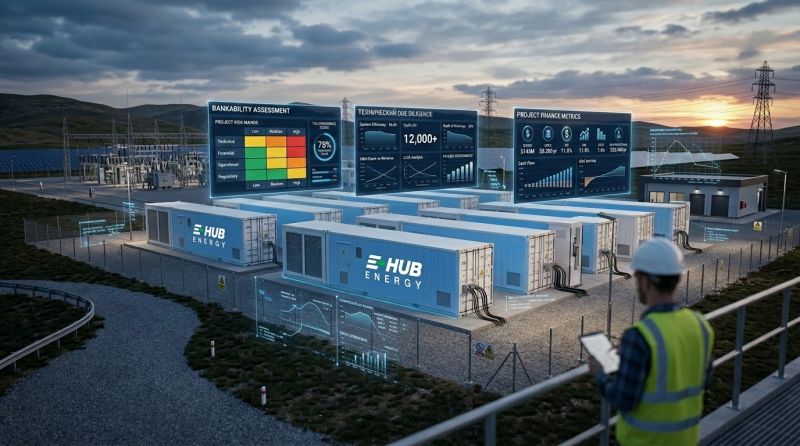
European banks are already financing BESS. But they are not financing “just a battery”.
In June 2026, R.Power secured approximately PLN 270 million in financing for a 150 MW energy storage project. In March, the EIB and Natixis CIB announced a financing programme of up to €507 million for PV and BESS projects in Italy.
This confirms that the BESS financing market exists. However, bankability does not come from the equipment brand or the length of the warranty. It emerges when the following elements form one coherent system:
- a predictable revenue model,
- technology matched to the operating profile,
- enforceable warranties,
- safety and insurance,
- EPC, O&M and optimisation agreements,
- access to operational data.
Two Different Assessment Paths
C&I BESS – the bank primarily assesses the customer, savings, equipment value, warranty and service.
Utility-scale BESS – the key factors are project cash flows, grid connection, revenue structure, contracts, market risk and full technical due diligence.
The Most Common Mistake
The financial model promises parameters that are not supported by the warranty or by the physical capabilities of the system. One example is calculating net AC-side energy when the warranty applies to the nominal DC cell capacity, or assuming constant capacity without a budget for augmentation.
E-HUB energy proposes two repeatable qualification packages: a simplified package for C&I projects and a full project-finance dossier for utility-scale projects.
If you are responsible for financing, leasing, credit risk, insurance or technical assessment of BESS projects, contact us.
Originally published by E-HUB energy on LinkedIn. View the original post.